Saturday, July 27, 2013

Welcome to the Gray


Morning came and I was greeted by gray skies. A lot of people don’t like gray skies. They are symbolic of things like sadness, or the absence of love, or of loss. Instead people wish for bright sunlight and pure blueness overhead.

I don’t always feel like that. Sometimes I’m fascinated by the gray. Not always, mind you. I don’t like a sky that is flat and monochromatic (although any decent photographer will tell you that there is beauty to be found in monochrome). The gray sky that captures me is the one that contains multitudes of textures and shadows. The clouds are at their various heights and seem to be holding back secrets and truths.

This is the sky of introspection.

The shades ranging from light gray to steel gray to deepest slate gray remind me of my soul. Most of us come out of a culture that paints things in black and white. We are told by the Powers That Be that life is to be confined to the simplest terms and most convenient definitions. Our side is good. The other side is evil. Our way is right. Someone else’s way is wrong. Be like me and you’ll be free.

The Church and the State have colluded in trying to keep us in line. It’s all black and white, we’re told. There are two kinds of people in the world – us and them. If we don’t want to be like them (the definition of “them” varies with whomever you’re talking to), then you’ve got to be like us.

It’s a lie. It’s just not that simplistic. I’m not just one shade, be it either black or white. As I consider the sky that reflects my heart, I see that I am many shades as well. I’ve lived a lot of years and done a lot of things. I’ve tried to make most of them good things. There are some that weren’t. They are all part of who I am.

Whoever I am today is due in large part to who I was yesterday – and last year and 10 years ago and on and on. Without the textures and shades that make up our past we have no present and cannot make a future. I’ve heard people say that we can forget the past or that the past does not define us. I don’t think that forgetting the past is good advice. There are lessons to be learned and love to be experienced in the past.  While the past doesn’t completely define us, it certainly informs who we are now. To refuse to at least acknowledge that is to lie to ourselves, to others and to God.

Just as important as acknowledging the past, sometimes we have to embrace it. We may not like all of it, but it is who we have been and part of who we are. Like a family member that sometimes make bad choices and still shows up at Thanksgiving, our past visits us and calls upon us to be honest with ourselves. The shades and textures of gray come to bring meaning and perspective to our lives.

I have not always liked who I was. There have been times that I wanted to be something different – someone different. On occasion it is still a struggle. Still, there are the special gray days when I look at the sky and can come to a moment of peace with it all. My soul is not one pure, solid color. It is many shades and textures. Some of them seem to be permanent, at least so far. Some of them come for a while and move on, merging with others to create something new.

What will it be tomorrow? I have no idea. the only sky I have is the sky of today. Tomorrow will bring its own special blend of sun and shadow. I’ll greet tomorrow when it’s here.

Today, I’m watching the clouds.

Thursday, April 11, 2013

The Power of Words


I’m always amazed and saddened when I look at things like Facebook, or a news broadcast and I see how much people seem to enjoy hating one another. The purpose of social media and communications in general has become the dissemination of lies and twisted interpretations of the truth. It’s not about exchanging thoughts and ideas anymore. It’s about bludgeoning someone with our own self righteousness. We keep hammering on someone else until we feel better.

The problem is we never feel better. We are so caught up in the shouting, name-calling and labeling that we don’t see the ricocheting, two-edged blade coming back at us. The scars we inflict on our perceived enemies are mirrors of the self-inflected wounds that we carry. We never heal. We never help anyone else heal. The pain we carry with us is blamed on others and so we retaliate, causing more pain. The vicious circle of hate multiplies.

This week, two things caused me to reflect this dark side of human behavior. One of the patients that I see regularly is a woman in her 80s from Cuba. Carmen and her family left their home during the rise of Fidel Castro and came to America to seek the freedom to live their lives as they chose. She is well educated, as was her husband. Her sons are all doctors. Her grandchildren are studying medicine or law at various schools around the country.

Carmen is confined to a bed or wheelchair most of the time. Her voice is not strong and so I have to listen very carefully when she speaks in her thick, beautiful Cuban accent. Many times Carmen has told me how fortunate we are to live in this country. She says it doesn’t matter who is President because we are free – much more so than in the homeland she left to come here.

The other day, though, she told me a story that frightened me. When Carmen arrived in America, she noted
the problems we were having as a country in dealing with racial issues. She looked at me, wonderingly, and said that she saw a door marked “For Whites Only” for the first time. “We never saw anything like that in Cuba,” she said. We spoke of the scars left on a people because of past injustices. Those scars are on all of us.

Later that evening, I turned on the TV and saw Elie Wiesel, writer, professor and recipient of the Nobel Peace Prize. Wiesel is also a survivor of the WWII concentration camps of Auschwitz and Buchenwald. As I looked at the photographs of the camps and the appalling images of the people who were sent there to be tortured and murdered, I felt the tears rise. How could human beings, created in the image of God, do these things to others also created in the image of God?

In 1993, I was in Germany. We were teaching conversational English to students in the former East Germany. One afternoon, our group visited the site of Buchenwald. Before we left, my host encouraged me to borrow a thick sweater. “It will be cold there,” she said. This was in mid-summer and the weather was mild, but I took it anyway. I’m glad I did. As I walked the ground strode upon by Nazis and saw the murder rooms and the ovens, I became chilled in a way I had never felt before. It was a chill that went deeper than the bone, all the way to the soul. It’s a chill that I have never quite shaken.

It’s not far from the concentration camps to the apartheid of South Africa and the race conflicts of America, symbolized by the “Whites Only” signs. It’s not far from any of these things to the words of hatred that we see and hear on a daily basis through TV, Facebook and other social media outlets. It’s not far from there to justifying imprisonment and even murder of those who don’t sound like us or think like us.

Can we really afford to allow this kind of hatred to rise again without saying anything? It’s stylish to hate online or in a broadcast. People do it all the time and we excuse it by saying, “They’re just making a point. They don’t really mean it.”

Of course they do. Those words that bully and inflame come from inside them. Words reflect thoughts and attitudes. Words eventually become deeds. We cannot let that happen.

Can’t we call out those who resort to the language of exclusivity and superiority? Not call out in the sense that we return hateful words for hateful words. Instead we must speak the truth that these words and attitudes are damaging to all of us, those who hear them and those who speak them. Instead of pointing out the worst in people, we must call out the best in them. We must help those who hate understand that they are capable of so much that is better and nobler.

Please – before it’s too late. Before there are doors we cannot walk through again. Before there are “special camps” for certain people. Before we, as a people and a nation, become the very thing that we say we stand against.

Wednesday, April 3, 2013

Clergy for the People


The other day I was reading the blog of my friend, Micheal Elliott. Micheal is a thought provoking writer and he’s even more thought provoking when you’re sitting around with him drinking coffee or something. It’s a gift.

Anyway, on this particular day, Micheal talked about the old TV show Daniel Boone, a product of Disney when they were making regular TV series. I remember the watching Daniel Boone myself. I admired him as he never missed with his flintlock rifle and made a hat of raccoon pelt look stylish and manly.

As good as he was, Daniel Boone (as played by Fess Parker) didn’t fire my imagination as did another character that got the Disney treatment. I remember to this day a three-part movie shown on what was known, I believe, as “Walt Disney’s Wonderful World of Color.” (Not everyone had color TV. If you had one, everyone wanted to watch TV at your house.)

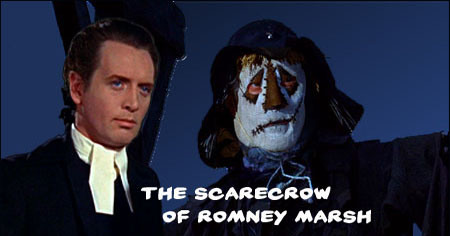
On those nights, I parked myself in front of our TV set (which got three channels clearly) to watch The Scarecrow of Romney Marsh. British actor Patrick McGoohan, before becoming a Secret Agent and then a Prisoner, played a vicar in an English coastal town. His name was Dr. Christopher Syn. A preacher named Dr. Syn (rhymes with sin) – you’ve got to love it!

Dr. Syn served as the shepherd of his congregation but he had a dark secret. By night, he was the infamous Scarecrow, sabotaging the efforts of the military, who were shanghaiing local men for the British Navy and extorting tax money over and above what was legal. The Scarecrow also ran a smuggling ring to help the local citizens obtain much needed supplies. Even his own gang did not know who this feared rebel/criminal really was.

Something about The Scarecrow was exciting to me. It was all about fighting against authority and standing up against oppression. It was also about danger and the possibility of getting shot or captured and subsequently hanged. Still, the cause was worth it and Dr. Syn was willing to do what needed to be done. He inspired the people of the countryside who helped him without knowing his true identity.

It makes me think about the actions of clergy today. Too many of our American pulpiteers are not avoiding the spotlight. Instead, they are seeking it out, making sure that as many people as possible know their names and faces. Instead of avoiding politics, they align themselves with one political party or another. Being a servant of all the people is not as important to them as being adored by a certain segment of the people.

Sadly, many who are identified with the Church are not really interested in saving people who don’t vote, can’t pay and have no homes.

Someone out there is saying, “Hey! A lot of preachers are talking about high taxes and the rights of citizens!”

Maybe. I’ve been looking at it for a long time, from both within and without the system. It still seems to me that the words of a lot of those preachers are promoting candidates, parties and political agendas. They do it while using religious language. If you disagree with them, it looks like you’re disagreeing with God (and we know what happens to people who do that).

Dr. Syn risked his life protecting people without asking them about their politics or where they were vis-à-vis the social order. He laid everything on the line for people who could never pay him back. He didn’t ask for their money, their support in the next election or a commitment to tithe. The Scarecrow didn’t see his actions as something divorced from his calling as a vicar. He saw that taking care of the poor, the oppressed and the weak was his calling.

Sounds like a Nazarene I read about.

I wonder what would happen if those who say they are called to care about the people actually did that. I mean cared about ALL the people without regard for who they are, where they are from, how much or how little money they have or their stance on various political issues. It might be enough to change the world.

Dr. Syn wore a mask, so no one would know his identity. Yes, it was for protection. It was also a symbol, showing that it wasn’t the man himself that was important. What was important was the cause to which the man gave himself. It was the people who were important.

Clergy, it may be time to become a clergy for the people. It’s time to cover the faces that show up on those TV broadcasts and in the attractive ads for those congregations with self-contained schools, gyms and societies. It’s time to go back to work for the people who need it most and can pay the least.

We have to ask ourselves the question: Is mine the face that people really need to see or is it the face of Another?

Friday, March 29, 2013

It's Friday . . . Is It Good?


It’s the beginning of Easter weekend. Good Friday. It’s the day that professing Christians honor as the day Jesus Christ was executed by the human Powers That Be. There will be worship services held. Profound words will be written and spoken. People will consider what it means to be immersed in the darkness that comes before the dawning.

At least, some people will.

A lot of other people will be caught up in the great controversies of the day, shouting their opinions at the top of their lungs, while shouting down those with differing opinions.

Lately, my Facebook feed has blown up with vitriolic attacks concerning deep and controversial issues. For
a while it was all about guns. Some people think we should restrict possession and sale of firearms, particularly assault-type weapons. Others think that by creating more restrictions, government will be infringing on the rights of the people. Here in Georgia, one of the most open gun law proposals in the country seems poised for approval.

Hot on the heels of the “Gun Fight” has come “Marriage Mayhem.” The Supreme Court of the United States of America has heard arguments concerning Proposition 8, a California law restricting marriage of same-sex couples. Does Proposition 8 meet the requirements of Constitutional law or does it not? We’ll soon find out this court’s opinion.

I’m not here to favor any argument over another. Do I have my opinions? Of course I do. I’m betting you do as well. What troubles me is that those people who should be most insistent on peace seem to be the most intent on conflict. According to my Facebook sampling, the most hateful, name-calling, grace-less group of people involved in these issues are – wait for it – Christians.

I can hear the protests beginning: “Now wait a minute – you don’t understand. All these opinions are an attack on Jesus and our faith. We are at war with the Godless (insert preferred hated group here)! God wants us to get rid of those folks.”

I’ve heard it on both sides of the issues. Each group is absolutely convinced that God is on their side (never mind being on God’s side) in the argument. This, of course, gives them a divine right to hate people of differing viewpoints and to excoriate anyone that may disagree with what is obviously God’s will.

I’m tired of it. I’m tired of the shouting and the condemnation and the name-calling. I’m tired of someone telling me that I have to choose one side and hate another. I’m tired of cop-out responses telling me that it’s not hate, it’s just about being right.

As Shakespeare said, “A pox on both your houses!”

As it happens, I number myself among those people called “Christian.” Because of that, I cannot enter this time of remembering the sacrifice of Christ while at the same time hating those for whom he died. To do so would to make Christ a liar.

For those who choose to continue to hate others in the name of love, I encourage you to go back to your desiccated places of worship. Lift your prayers to the ceiling, because that’s as high as they will go. Pretend to honor God if it makes you feel better, but consider this: Each act of hatred, each slanderous word, and each action of exclusivity is a nail in the body of the savior you claim to honor and follow.

Happy Easter.

Wednesday, March 6, 2013

The Friends of St. Patrick's Day

St. Patrick’s Day is coming and I intend to participate. I love St. Patrick’s Day. Perhaps it’s because of my alleged Irish ancestry. At any rate, I know that I love Irish music, Irish stories, and even Irish food (if you don’t like Shepherd’s Pie or Irish stew, you’ve never had them done right). Guinness? You decide.

I will be observing St. Patrick’s Day, but I won’t be at the legendary Savannah parade and party. I won’t be at any parties at all. Sadly, I won’t be in Ireland although I dearly want to go and visit there again.

Instead, I’ll be quietly doing my own thing – listening to Irish/Celtic music, reading a bit on Celtic spirituality and being more than a bit contemplative. I’ll also be wearing green. Some traditions shouldn’t be messed with.

Recently, my niece shared a link to an article written by a ministerial colleague of hers. This colleague talks about something she calls “holy friendship.” She speaks about people who take strength and camaraderie from one another. Conversations, while including things mundane or even silly, always include something deeper and more meaningful. There is a sometimes unspoken understanding that the connections being shared find their origin and meaning in what the Irish Celts would have called “The Thin Place.”

The Thin Place is the place where the boundary between the earthly and the spiritual is most ethereal – most permeable. It allows communication to move more freely from human to divine and back again. It can be anywhere, but is most often thought of in terms of intersections. It’s where earth meets sky or sky touches ocean. It can be where mountain greets desert. I believe it can also be where heart meets heart.

When I was very young, I spent a great deal of my time alone. It wasn’t until much later that I began to understand what it might mean to experience a relationship in which I could share true glimpses of who I am and receive them from others. It wasn’t easy to learn. Trust can be difficult to build and once it’s built it can be quickly destroyed. It takes a real friend – a “holy friend” – to walk with you and work with you, building and re-building trust and love.

I’ve been blessed by some grace-filled people in my life. They have stood by me and occasionally stood up to me. They don’t ask that I be anyone other than who I am. They expect the same in return. Some of these people have come and gone in my life. Some have come, gone and come back again. The timing is never my choice but it often seems that it happens when it is most important. I consider these to be holy times.

When I was in college, I encountered people that changed my life – mostly for the good. Some of those people became dearer to me than I thought possible. When I moved on from college, I lost most of those people. It took a while – decades, actually – but through the miracle of social media, some of us rediscovered one another. That was miracle enough, but we also discovered that our friendship was still held fast in our hearts, as we readily embraced one another again. We can’t get together as often as we want, but I know that they are still there.

Holy friendship.

Cousins that I had thought never to see or hear from again have found me through their own excursions into social media. Who would have believed it? Not I. At least I wouldn’t have believed it before. Now I believe that when the time and our hearts are right, we can experience the miraculous birth and rebirth of relationships. It’s a holy thing.

Most of us have acquaintances. These are people with whom we interact in our daily living. Most of us have some circle that we call friends. These are people with whom we share common interests or values and make up some part of our social experience. Some of us may be fortunate enough to have people in our lives that embody the Thin Place. These are the people through whom we catch a glimpse of the divine. They are those with whom we can share the spark of the divine that lives in us.

These kinds of relationships don’t happen by accident. They must be intentional. They must be nurtured and treasured. They must be acknowledged for what they are so that we can see the holiness that happens when we laugh or cry or sit together in companionable holy silence.

It’s about being a Thin Place for one another. Mel Shlacter, of Trinity Episcopal Church in Iowa City, said: “Thin Places are the destinations of pilgrimage, and the journey can be just as well through the heart as over land and sea.”

Too often we are all about the destination. We should pay much more attention to the journey and the companions that are part of the journey. The destination will be there with the time is right. For now, I just want to be on the road in good company.

Tuesday, January 29, 2013

The Gumbo of Life

I was talking with a dear friend this morning. Well, okay, I wasn’t talking. I was sending a message via Facebook. I understand that it’s not the same, even though a large segment of the population seems to think it is. People have virtual conversations with virtual representations of other people, some of whom they’ve never met in real life, and call it “talking with a friend.”
Still, I was communicating with my friend, Micheal Elliott, concerning something he wrote. Micheal is a great writer and I urge you, if you haven’t, to check out his books. You can find them on Amazon and at other purveyors of fine literature.
Today, Micheal was talking about his love for Tybee Island even though it isn’t the same place it was when he wrote Running with the Dolphins. Nothing stays the same. Change is the only real constant in the human universe.
Change comes to all of us. It doesn’t matter whether or not we want it, welcome it or make war against it. It’s going to happen. Some of the changes may be pleasant for us. Many of the changes will not. When they do come, we are bound to look behind us and find that the reflections of days gone by have a flavor that is bittersweet. There was a wonderful taste to the first forays into life, learning and love. They were special times. We learned about ourselves and the things we could do. We fell in love for the first time. We left home for the great big world. We traveled to places we’d never been before.
Sweet.
Somewhere along the line, we began learning about ourselves and the things we couldn’t do. We discovered that there were things we weren’t allowed to do. Someone broke our hearts. Maybe we broke someone’s heart. The world was not what we had been promised.
Bitter.
Sometimes I look back. Maybe I look back to often, because I like the sweet. I want to recapture what was and make it into what is. That doesn’t work. No matter what I do, the nature of the world remains as it is. Serious. Painful. Uncertain. We just can’t tell what’s in the mix for us and how it will taste.
When I was a child, my mother would occasionally make gumbo. Gumbo is a strange concoction from Louisiana. It looks like something that you would throw out because it was in the refrigerator too long and was undergoing some kind of strange fermentation/molding process.
I would come home in the evening and I’d smell something good from the area of the kitchen.
“What are we having for dinner?”
“Gumbo,” she’d say.
I would stroll to the stove and look in the pot and see something that looked like it should be in some wizard’s cauldron. I was not at all sure I wanted to try that greenish/grayish potion for fear that my stomach would rebel in a dramatic and painful way.
Chicken would be added to the mixture and maybe some smoked sausage. When it was done, the whole thing was served over rice. Amazing! It was delicious and I always asked for seconds. Who knew that this strange looking brew would be so good?
Life is a lot like this strange culinary masterpiece. Often it looks like a mess and we want no part of it. When we taste it, we find that it’s not nearly what we thought it would be and that there are a lot of ingredients that we enjoy.
Life simmers and occasionally boils around us. Sometimes it’s not what we expected. Truthfully, it’s rarely what we expect. The proof is in the tasting. We can long for the sweet taste of what was past. We can take offense at the bitterness that we experience in the present.
We can also, if we choose, use the flavors of the past that we love so well to season our present and become part of the overall experience. It won’t be just like “mom used to make.” It won’t be the sweet taste of remembrance.
But it may be something we can savor for a long time.

Friday, December 28, 2012

'Twas the Week After Christmas

Okay, Christmas is pretty much over for this year. People have cleaned up, some have gone back to work, and we're still making sandwiches out of the leftover ham. Gifts have been given and received. Hopefully, you were given something you needed/wanted. More hopefully, you gifted others similarly. Most hopefully of all, you didn't get a fruitcake for Christmas.

I don't understand the purpose of fruitcake. Why does someone take bits of dried, tasteless fruit and other less identifiable things, suspend them in a dense organic paste and bake it all to the consistency of a cinder block? Seriously, you could build a fall-out shelter out of some of the fruitcakes I've seen. Do people really eat that stuff? Have you noticed that no matter how long a fruitcake sits around, it stays the same? These things have a shelf life to rival the most preservative-infused snack food on the rack of any local convenience store. Even the bugs won't eat it. I really think that there are only a relatively small number of fruitcakes in existence. They just get re-gifted year after year until it seems like they're everywhere. I believe it to be some kind of conspiracy.

Now that Christmas of 2012 has passed, we are staring into the headlight of the oncoming locomotive that is 2013 (insert screams of panic and prophesies of doom here). We've passed the ending dates of the Mayan calendar, so we're heading into uncharted waters. Some people find that frightening. I find it encouraging. We're going off the map into territory where things might not go as predicted. We might not be able to impose our will over everything and make everyone march to the same familiar drum beat. It's a whole new game.

Or at least it can be.

There are so many things that don't have to be the same as they were this year. Certainly there are things we have no real control over. Politicians will still prefer to pound each other into political powder than to actually address the issues that face our country. Americans will still vote for them because the aforementioned politicians have good rhetoric. Nothing else - just good rhetoric. Perhaps worst of all, reality TV will continue to grow as a staple of broadcast entertainment.

Even so, we can still do things to insure that 2013 doesn't become the juggernaut that many of us fear. So, here are a few things - in my opinion - that will help make the next year something special. In a good way.

1. Extend your charity to beyond December. There are all knids of stories about feeding families and taking care of children in December. Christmas makes us think about the people who don't have toys for their children or a Christmas dinner or a home in which to park a Christmas tree. Those who can do something about that should do something about that. Here's the thing: people will still be hungry and homeless in February or March or June. Often it seems as though our "Christmas spirit" is really just a temporary good mood. Not many people are as interested in feeding, clothing or housing those who need help if it's not December. There are people still hungry or sleeping in the streets in the Spring, Summer and Fall. Where are the people who believe in Christmas?

2. Start looking at people as human beings, not as stereotypes of their nationality, religion, race or gender. They have beautiful gifts to share. Let them.

3. Stop watching reality TV. You're not doing Honey Boo Boo any favors.

4. Spend more time with family. I know, sometimes they're irritating. Sometimes it seems like you'll have them forever. You won't.

5. Say "thank you" to someone who has influenced your life for the better. They deserve to hear it and we'll be better people for having said it.

6. Stop watching reality TV. It needed saying again.

7. Slow down. Breathe deeply. Take notice of small, quiet things. It is from the small, quiet things that God speaks most clearly and eloquently.

These are just a few things. I could think of a lot more. So could you. In face, you should. Make your own list of ways the world could be made better in 2013. Then, take your list and live it.

Be the 2013 you want to see.